How do clear aligners work?
Treatment starts with a three-dimensional digital model of your teeth. On this model, every step from the current position of the teeth to the target position is planned on the computer, and a separate aligner is made for each step. Each aligner moves the teeth a very small amount further than the previous one. The slight tightness you feel when you put in a new aligner is this controlled force acting on the teeth.
For some tooth movements, small tooth-coloured bumps are bonded to the surface of the teeth. Called attachments, they help the aligner grip the tooth better; they are polished off at the end of treatment. When needed, elastics between the upper and lower jaws are also used.
Who are they suitable for?
Many cases of crowding, gaps between the teeth, deep or open bite and bite discrepancies can be treated with clear aligners. However, not every problem can be corrected as predictably with aligners. Some complex tooth movements or jaw discrepancies may require braces, auxiliary methods together with aligners, or surgery. Which method suits you is decided after the examination and records are reviewed.
The most important condition for aligner treatment is regular wear. Because the aligners are removable, the progress of treatment is largely in your hands.
Digital planning
The impression is taken digitally with an intraoral scanner; no impression material is used. The scan takes a few minutes and creates a three-dimensional model of your teeth. In the plan prepared on this model, we look together on screen at how the teeth will move step by step and at the target final position.
A digital plan is a goal, not a guarantee of the result. Tooth movement is a biological process and varies from person to person. If the teeth do not progress according to the plan, a new scan can be taken and additional aligners made.
Daily use
- The aligners must be worn 20–22 hours a day; they are removed only for eating and brushing your teeth.
- Drink only water while wearing the aligners. Drinks such as tea, coffee and fruit juice can stay under the aligner and cause decay and staining; hot drinks can distort the aligner.
- After eating, brush your teeth before putting the aligners back in. If you cannot brush, at least rinse your mouth thoroughly with water.
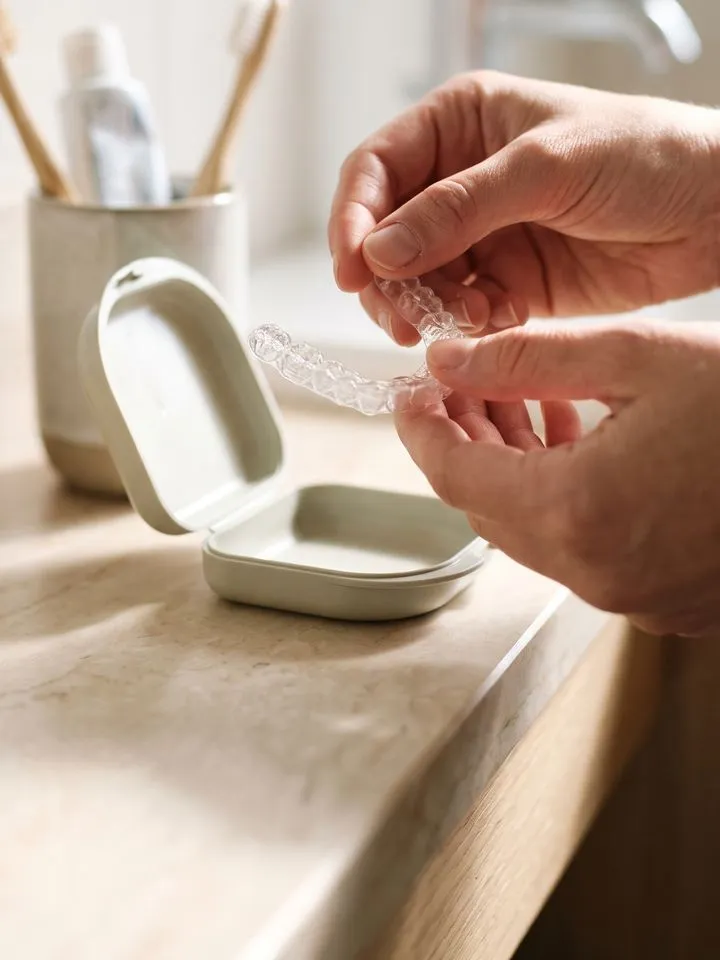
- Keep the aligners in their case when you take them out; aligners wrapped in a napkin are easily lost.
- Clean the aligners with a soft brush and cold or lukewarm water; hot water can distort them.
- Switch to the next aligner according to the schedule you are given. Switching in the evening lets the tightness of the first hours pass while you sleep.
You can follow which aligner you are on and the date of your next switch in the Patient Panel.
What is interproximal reduction?
In some treatments, a very thin layer of enamel is removed from the sides of the teeth to create space or to make tooth shapes match each other. This is called interproximal reduction (IPR). The amount removed is in the order of a tenth of a millimetre and is planned within the safe thickness limits of the enamel. No anaesthetic is needed. The same procedure can also be used in treatment with braces.
Check-ups
Check-ups usually take place every 6–10 weeks. At a check-up, we assess whether the aligners fit the teeth fully, whether the teeth are progressing according to the plan and the condition of the attachments; the next aligners are then handed over.
After treatment
With aligners too, the teeth tend to move back towards their old positions after active treatment. That is why retainers are used at the end of treatment.
More information about clear aligner treatment is also available at seffafplakbursa.com (in Turkish).